John Scarne『Scarne's New Complete Guide to Gambling』
Herbert Asbury『Sucker's Progress』(1938年)
S. N. Ethier, F. M. Hoppe「A world record in Atlantic City and the length of the shooter's hand at craps」(The Mathematical Intelligencer, 2010年)
Guinness World Records「Longest craps roll」
Las Vegas Advisor「Golden Arm Club」
An English ancestor called hazard
Craps descends from hazard, a dice game played in medieval England. One legend says it was named after a castle called Hazart, besieged by crusaders who passed the time with dice. In the 14th century Chaucer's Canterbury Tales already condemns it as a ruinous vice.
The English word "hazard" itself is said to come from the game. Hazard, though, was complicated: the caster first chose a "main" number between 5 and 9, among other rules.
A young aristocrat in New Orleans
The man usually credited with bringing hazard to America is Bernard de Marigny, heir to a great Louisiana landowning family. Back from London around 1805, he introduced the game in New Orleans, where it was simplified into a version built around the number 7.
New Orleans society was not interested, but the new game caught on among dockworkers and field hands and travelled up the Mississippi. Pleased with its success, Marigny named a street in his new subdivision Rue de Craps (it was later renamed Burgundy Street).
Where the name comes from
In hazard the lowest throw, 2, was called "crabs". The most popular theory is that "crabs" became "craps", and we still call 2, 3 and 12 "craps" today.
Another theory points to "Johnny Crapaud", a mocking nickname for the French ("crapaud" means toad): players crouching over their dice in the street were said to look like toads.
The dice maker who invented Don't Pass
In the street games of the 19th century, players bet against each other and the bankers running the game often used crooked dice. The man who changed that was John H. Winn, a dice maker in Philadelphia.
Around 1907 Winn added Don't Pass to the layout so that players could bet against the shooter. If customers could bet either way, loaded dice were no use to the house. Don't Pass at first carried a 5% commission; that gave way to barring the come-out 3, and later to today's rule of barring the 12. Winn is still called the father of modern craps.
From back alleys to Las Vegas
Needing only two dice and a wall, craps also became a favourite pastime of soldiers, and the wars of the 20th century spread it among young Americans everywhere. When Nevada legalised gambling in 1931, craps became the star of the Las Vegas casinos and long remained the king of the table games.
The whole table cheering for the same shooter and roaring at every number: that shared excitement is why craps is still loved today.
154 rolls in 4 hours 18 minutes
On 23 May 2009, at the Borgata in Atlantic City, Patricia DeMauro of New Jersey rolled the dice 154 times before sevening out. It took 4 hours and 18 minutes, and it was only the second time she had ever played craps.
The previous record was 118 rolls in 3 hours 6 minutes by Stanley Fujitake at the California Hotel in Las Vegas in 1989. In his honour the hotel created the Golden Arm Club for shooters who roll for more than an hour.
Reports at the time quoted odds of 1 in 1.56 trillion, but that figure counts even the winning 7s on the come-out as losses. Worked out properly, a hand of 154 rolls or more comes along about once in 5.6 billion hands. Still a staggering record.
Superstitions at the craps table
Once a point is set, never say "seven" at the table. If you must, call it "big red" or something like it.
Many players believe dice that hit someone's hand will roll a 7, so keep your hands off the rail while the shooter throws.
When a die flies off the table, some shooters ask for "same dice".
Craps in numbers
Opposite faces of a die always add up to 7. The number is built into the dice themselves.
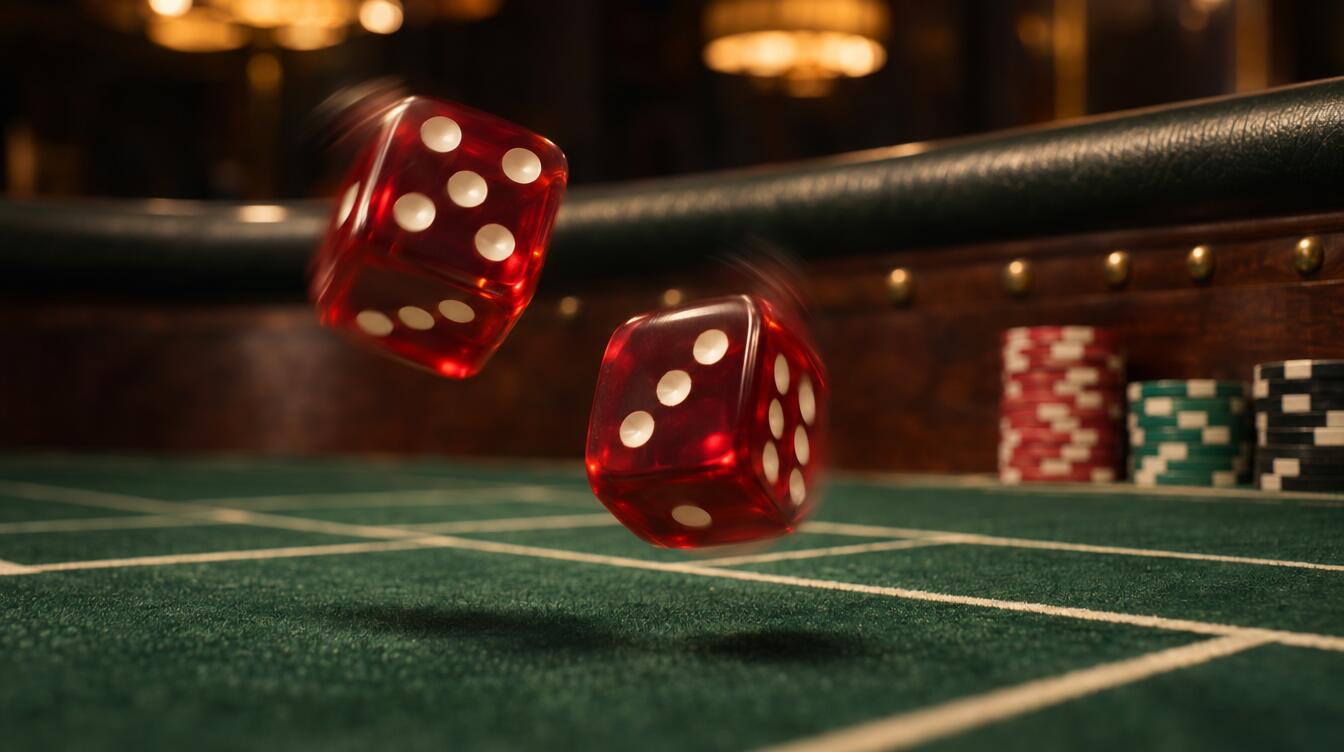
Casino dice are clear cubes about 19 mm (3/4 inch) across with sharp corners and a serial number on each pair. The pips are drilled and filled with paint weighing the same as the material removed.
A shooter's hand lasts about 8.5 rolls on average. Rolling for more than an hour is very rare.
Seven comes up six ways out of 36, once in six rolls: more often than any other total.
Main sources
John Scarne, Scarne's New Complete Guide to Gambling
Herbert Asbury, Sucker's Progress (1938)
S. N. Ethier and F. M. Hoppe, "A world record in Atlantic City and the length of the shooter's hand at craps", The Mathematical Intelligencer (2010)
John Scarne《Scarne's New Complete Guide to Gambling》
Herbert Asbury《Sucker's Progress》(1938年)
S. N. Ethier, F. M. Hoppe “A world record in Atlantic City and the length of the shooter's hand at craps”(The Mathematical Intelligencer,2010年)
Guinness World Records “Longest craps roll”
Las Vegas Advisor “Golden Arm Club”
조상은 영국의 '해저드'
크랩스의 조상은 중세 영국에서 유행한 '해저드'라는 주사위 도박입니다. 십자군 시대에 하자르트라는 성을 포위하던 병사들이 즐긴 것이 이름의 유래라는 전설도 있습니다. 14세기 초서의 『캔터베리 이야기』에도 신세를 망치는 도박으로 등장할 만큼 널리 알려져 있었습니다.
영어 hazard(위험)라는 말 자체가 이 주사위 놀이에서 왔다고 합니다. 다만 해저드는 던지는 사람이 '노릴 숫자'를 5〜9 중에서 고르는 등 규칙이 꽤 복잡했습니다.
뉴올리언스의 젊은 귀족
해저드를 미국에 들여온 인물로 이름이 오르는 것은, 루이지애나 대지주 집안에서 태어난 베르나르 드 마리니입니다. 1805년쯤 런던에서 돌아온 그가 뉴올리언스에 퍼뜨린 해저드는 7을 특별한 숫자로 삼는 간단한 규칙으로 바뀌어 갔습니다.
상류층에게는 인기가 없었던 이 새 놀이는 항구와 농장에서 일하는 사람들 사이에서 대유행하며 미시시피강을 거슬러 전미로 퍼졌습니다. 기분이 좋아진 마리니는 자신이 개발한 구역의 거리 하나에 '크랩스 거리'라는 이름을 붙였습니다(나중에 버건디 거리로 이름이 바뀌었습니다).
'크랩스'라는 이름
해저드에서는 가장 작은 눈인 2를 '크랩스(crabs=게)'라고 불렀습니다. 이것이 변해 '크랩스(craps)'가 되었다는 것이 유력한 설입니다. 지금도 2·3·12를 '크랩스'라고 부르는 것은 그 흔적입니다.
프랑스인을 놀리는 별명 '조니 크라포(두꺼비)'에서 왔다는 설도 있습니다. 길가에 쭈그리고 앉아 주사위를 던지는 모습이 두꺼비처럼 보였다는 것입니다.
돈트 패스를 발명한 주사위 장인
19세기 길거리 크랩스에서는 플레이어끼리 돈을 걸었고, 판을 여는 사람이 속임수 주사위를 쓰는 일도 드물지 않았습니다. 이 상황을 바꾼 것이 필라델피아의 주사위 장인 존 H. 윈입니다.
1907년쯤 윈은 슈터의 실패에 걸 수 있는 '돈트 패스'를 레이아웃에 더했습니다. 손님이 양쪽 어디에나 걸 수 있다면 조작한 주사위를 쓸 의미가 없어집니다. 처음에 돈트 패스에는 5%의 수수료가 붙었지만, 이후 컴 아웃의 3을 무승부로 하는 방식을 거쳐 지금의 '12는 무승부'로 바뀌었습니다. 윈은 지금도 '근대 크랩스의 아버지'로 불립니다.
뒷골목에서 라스베이거스로
주사위 두 개와 벽만 있으면 즐길 수 있는 크랩스는 병사들의 오락으로도 퍼져, 20세기의 전쟁을 거치며 미국 전역의 젊은이들에게 알려졌습니다. 1931년 네바다주가 도박을 합법화하자 크랩스는 라스베이거스 카지노의 꽃이 되었고, 오랫동안 테이블 게임의 주역으로 군림했습니다.
테이블을 둘러싼 모두가 같은 슈터를 응원하고, 숫자가 나올 때마다 환호성이 터진다. 함께 달아오르는 이 분위기야말로 크랩스가 지금도 사랑받는 이유입니다.
4시간 18분, 154투
2009년 5월 23일, 애틀랜틱시티의 보르가타에서 뉴저지주의 퍼트리샤 드마우로 씨가 세븐 아웃할 때까지 154번 주사위를 계속 던졌습니다. 시간으로는 4시간 18분. 그녀가 크랩스를 한 것은 이것이 인생에서 두 번째였다고 합니다.
그때까지의 기록은 1989년 라스베이거스의 캘리포니아 호텔에서 스탠리 후지타케 씨가 세운 118투·3시간 6분. 이 위업을 기리기 위해 호텔은 한 시간 넘게 계속 던진 사람을 표창하는 '골든 암 클럽'을 만들었습니다.
당시 보도에서는 '1조 5,600억분의 1'이라는 확률이 소개되었지만, 이는 컴 아웃 롤의 7(이기는 7)까지 패배로 센 계산입니다. 바르게 계산하면 154투 이상 이어질 확률은 약 56억분의 1입니다. 그래도 엄청난 기록인 것은 변함없습니다.
크랩스의 징크스
포인트가 정해진 뒤 테이블에서 '세븐'이라고 말하는 것은 금물. 꼭 말해야 할 때는 '빅 레드' 같은 말로 바꿔 부릅니다.
주사위가 사람 손에 맞으면 7이 나온다며 싫어하는 사람이 있습니다. 슈터가 던질 때는 손을 레일 위에 내밀지 않는 것이 매너입니다.
주사위가 테이블 밖으로 튀어 나가면 '같은 주사위로'라고 부탁하는 슈터도 있습니다.
숫자로 보는 크랩스
주사위의 마주 보는 면의 합은 반드시 7. 7은 주사위 자체에 새겨진 숫자입니다.
카지노의 주사위는 한 변 약 19mm의 투명한 정육면체로, 모서리가 날카롭고 한 쌍마다 일련번호가 새겨져 있습니다. 눈의 홈에는 깎아 낸 만큼과 같은 무게의 도료가 채워져 있습니다.
슈터 차례의 길이는 평균 약 8.5투. 한 시간을 넘는 것은 극소수입니다.
7은 36가지 중 6가지로, 6번에 1번. 어느 숫자보다도 잘 나오는 눈입니다.
주요 참고 자료
John Scarne 『Scarne's New Complete Guide to Gambling』
Herbert Asbury 『Sucker's Progress』(1938년)
S. N. Ethier, F. M. Hoppe 「A world record in Atlantic City and the length of the shooter's hand at craps」(The Mathematical Intelligencer, 2010년)