The Diagram Group『The Official World Encyclopedia of Sports and Games』
John Scarne『Scarne's New Complete Guide to Gambling』
Encyclopædia Britannica「Sic bo」「Chuck-a-luck」
マカオ特別行政区政府 博彩監察協調局(DICJ)
A game of many names
"Sic bo" is the Cantonese reading of the Chinese 骰寶, "precious dice". In Cantonese it is also called "tai sai" or "dai siu" (big small), and the Japanese and Korean names come from the same words. In the Philippines it is played as "hi-lo".
Nearly every one of these names comes from the most popular bet of all: big or small.
A dice game said to come from ancient China
Sic bo is said to have its roots in ancient China, but there is no firm record of when or how it began. Games of betting on the totals and combinations of three dice seem to have been played for a very long time at Chinese fairs and festivals.
In the 19th and 20th centuries the game travelled with Chinese emigrants to America and Southeast Asia, where it was gradually shaped into a casino table game.
Western cousins
The West had its own three-dice games. In the English game of grand hazard, the dice were rolled down a chute fitted with sloping boards (the "hazard chute") to produce a result.
The American game of chuck-a-luck put three dice in an hourglass-shaped wire cage that was spun over to throw them, which is why it was also called "birdcage". Players simply bet on single numbers. It was once common in Nevada casinos, but nearly all of those cages have since given way to sic bo tables.
A Macau favourite
Sic bo is most at home in Asia, and above all in Macau. Its tables stand in rows alongside baccarat, and every result is greeted with a roar. Next to each table a board shows the latest results with their big or small and odd or even, and players studying it before the next round are a familiar sight.
Dice rattling under the lid
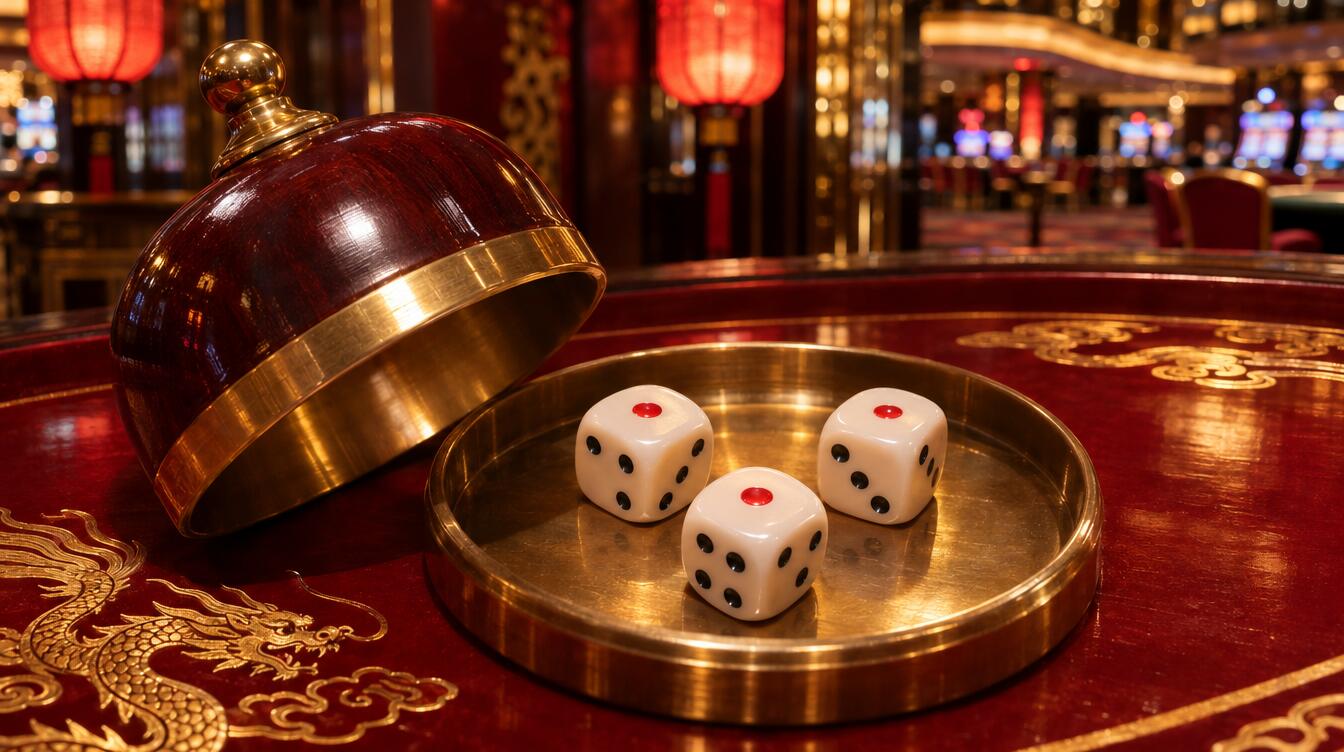
In traditional sic bo, the dealer puts the dice in a dish with a cover and shakes it with the lid on. The rattling stops, the lid lifts, and that moment is the high point of the game.
Modern casinos also use automatic shakers that vibrate the dice under a glass dome. With no hands touching the dice, cheating is harder, and the result goes straight to an electronic layout that lights up every winning area at once.
Three dice around Asia
Games with three dice turn up all over Asia. In Japan, players have long thrown three dice into a rice bowl to compete for the best combination in a game called chinchirorin. Unlike sic bo, where everyone plays against the house, chinchirorin pits a banker against the other players to see whose roll is stronger.
Sic bo in numbers
Three dice can land 6 × 6 × 6 = 216 ways. Ignoring order, there are 56 different combinations.
A triple comes up one time in 36 (2.78%), which is exactly the house edge on big and small.
The most common totals are 10 and 11, with 27 ways each out of 216 (12.5%).
All three dice show different numbers 55.6% of the time, so in more than half the rounds no two dice match.
Main sources
The Diagram Group, The Official World Encyclopedia of Sports and Games
John Scarne, Scarne's New Complete Guide to Gambling
Encyclopædia Britannica, "Sic bo" and "Chuck-a-luck"
Gaming Inspection and Coordination Bureau of the Macao SAR (DICJ)
The Diagram Group《The Official World Encyclopedia of Sports and Games》
John Scarne《Scarne's New Complete Guide to Gambling》
Encyclopædia Britannica “Sic bo”“Chuck-a-luck”
澳门特别行政区政府 博彩监察协调局(DICJ)
이름이 여러 개인 게임
영어권에서 통하는 '식보(sic bo)'는 중국어 '骰寶'의 광둥어 발음으로 '보배로운 주사위'라는 뜻입니다. 광둥어로는 '대세(大細, 다이사이)'라고도 불리며, 한국의 '다이사이'와 일본의 '大小'도 같은 계통의 이름입니다. 필리핀에서는 '하이로'라는 이름으로 즐깁니다.
어느 이름이든 가장 인기 있는 베팅인 '대냐 소냐'에서 왔다는 점이 재미있습니다.
고대 중국에서 태어났다는 주사위 놀이
다이사이는 고대 중국에 기원을 둔다고 하지만, 언제 누가 시작했는지 보여 주는 확실한 기록은 없습니다. 주사위 3개의 합계나 조합에 거는 놀이는 중국 각지의 축제와 장터에서 오랫동안 즐겨 왔다고 여겨집니다.
19세기에서 20세기에 걸쳐 중국 이민자들과 함께 미국과 동남아시아로 건너갔고, 점차 카지노의 테이블 게임으로 다듬어졌습니다.
서양의 사촌들
주사위 3개에 거는 게임은 서양에도 있었습니다. 영국의 '그랜드 해저드'는 경사판이 달린 통(해저드 슈트)에 주사위를 굴려 결과를 내는 놀이입니다.
미국의 '척 어 럭'은 모래시계 모양의 철망 바구니에 주사위 3개를 넣고 빙글 돌려 결과를 내기 때문에 '버드케이지(새장)'라고도 불렸습니다. 거는 방법은 눈 하나에 거는 것뿐인 단순한 게임으로, 한때는 네바다주 카지노에서도 흔히 볼 수 있었지만, 지금은 대부분 다이사이 테이블로 바뀌었습니다.
마카오의 단골 게임
다이사이가 가장 활발한 곳은 아시아, 그중에서도 마카오입니다. 마카오의 카지노에서는 바카라와 나란히 다이사이 테이블이 줄지어 서 있고, 결과가 나올 때마다 큰 환호성이 터집니다. 테이블 옆 전광판에는 최근 결과가 '대·소', '홀·짝'과 함께 표시되고, 그것을 보며 다음 승부를 궁리하는 손님의 모습도 익숙한 풍경입니다.
뚜껑 속에서 울리는 주사위
전통적인 다이사이에서는 딜러가 접시와 뚜껑이 달린 용기에 주사위를 넣고 뚜껑을 덮은 채 흔듭니다. 달그락거리는 소리가 멈추고 뚜껑이 들리는 순간이 이 게임의 하이라이트입니다.
지금의 카지노에서는 유리 돔 안에서 주사위를 진동시키는 자동 셰이커도 널리 쓰입니다. 사람 손을 거치지 않아 부정을 막기 쉽고, 결과는 그대로 전자 레이아웃으로 보내져 당첨된 구역이 한꺼번에 빛납니다.
아시아의 주사위 3개 놀이
주사위 3개를 쓰는 놀이는 아시아 곳곳에 있습니다. 일본에는 사발에 주사위 3개를 던져 넣고 족보를 겨루는 '친치로린'이 예부터 친숙합니다. 모두가 카지노와 승부하는 다이사이와 달리, 친치로린은 물주와 다른 사람들이 나온 눈의 세기를 겨루는 점이 크게 다릅니다.
숫자로 보는 다이사이
주사위 3개의 결과는 6×6×6=216가지. 순서를 따지지 않으면 눈의 조합은 56종류입니다.
트리플이 나올 확률은 36분의 1(2.78%). 이 숫자가 그대로 대·소의 하우스 엣지입니다.
가장 잘 나오는 합계는 10과 11로, 각각 216가지 중 27가지(12.5%)입니다.
세 개 모두 다른 눈이 나올 확률은 55.6%. 절반이 넘는 판에서 같은 눈이 하나도 없습니다.
주요 참고 자료
The Diagram Group 『The Official World Encyclopedia of Sports and Games』
John Scarne 『Scarne's New Complete Guide to Gambling』